Textiles & Their Making
How Honeycomb Weave Shapes the St Genève Avalon Linen Throw
Texture can change the whole character of a textile. In the Avalon throw, a honeycomb weave gives pure linen a softly sculpted surface and an airy drape—an interplay of fiber and structure that feels as considered as it looks.
Published October 31, 2026
A throw is one of the most intimate objects in a room. It rests within reach on the arm of a chair, follows a reader from sofa to fireside, or settles across a bed as a final, informal layer. Its purpose is practical, but its presence is expressive: a change in texture can bring quiet dimension to a room without asking for attention. The St Genève Avalon Linen Throw makes that point through a simple but distinctive combination—pure linen and a honeycomb weave.
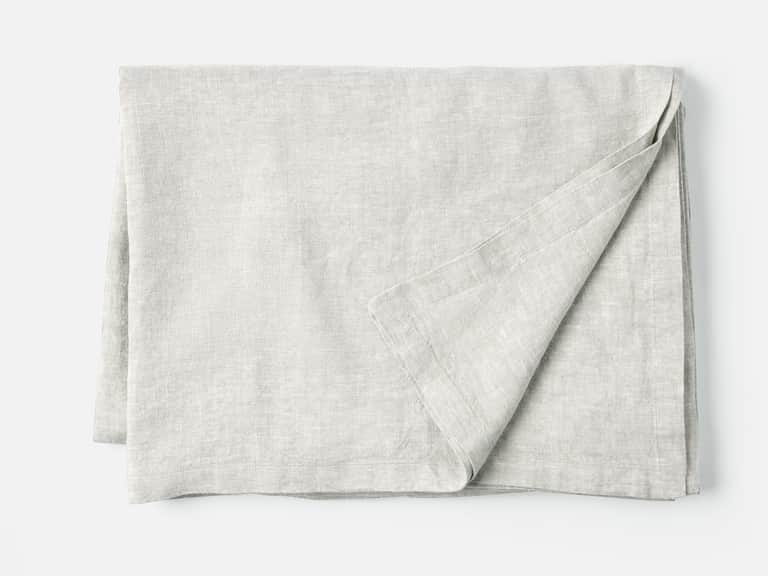
Woven in Portugal from 100% linen and sewn in Canada, Avalon is described as lightweight yet cozy, with a soft, airy texture and a natural-white hue. Its honeycomb construction gives the surface a raised, cell-like appearance, while linen contributes the characteristic irregularity and relaxed tactility of a plant-based yarn. The effect is not merely decorative. Weave structure influences the way fabric bends, catches light, feels against the hand, and falls when draped.
Understanding those relationships makes this throw more than a finishing touch. It becomes a compact lesson in textile construction: how fiber establishes a material’s basic personality, how the weave shapes its surface and movement, and how careful finishing helps a household textile meet the rhythms of everyday use.
What a honeycomb weave brings to linen
Honeycomb is a descriptive name for a woven structure that creates a pattern of raised and recessed areas, often arranged in small, repeating cells. Those hollows and ridges give the fabric visual relief: rather than appearing entirely flat, the surface seems to hold a quiet geometry. In a throw, this dimensionality can make a single color feel more nuanced. Light moves across the high points and settles into the lower ones, lending the textile definition without relying on a printed motif or contrasting color.
The word “honeycomb” describes the look and texture, not a guarantee that every fabric bearing the name has precisely the same construction. Textile structures vary, and the details depend on how yarns interlace and how the fabric is finished. It is safest to treat the term as a useful description of the raised, cell-like effect rather than as a complete technical specification. For Avalon, the stated feature is its unique honeycomb weave, which creates an airy texture and a beautiful drape.
Texture and drape are closely related. A highly compact, flat cloth may fall in a different way from a fabric with pronounced relief. In a honeycomb textile, the sculpted surface can lend a sense of body while the open, dimensional character keeps the overall impression from feeling visually heavy. This balance helps explain why a woven throw can look substantial enough to layer yet still seem relaxed and light in the room.
That balance is also a matter of styling. A textured throw introduces contrast beside smooth upholstery, crisp sheets, or a polished wooden surface. Because the pattern comes from the weave itself, it can complement a range of surroundings without becoming the dominant feature. On Avalon, natural white keeps the emphasis on the fabric’s relief: the eye reads the structure through shadow and surface rather than through a strong color shift.
Why fiber choice matters
Weave is only part of a textile’s story. The yarn matters just as much. Linen is made from flax, a plant fiber valued in household textiles for its strength and distinctive handle. Its surface is rarely as uniform as a highly processed, perfectly smooth yarn; subtle variations in thickness and character are part of its appeal. In the Avalon throw, those natural details meet the repeated architecture of the honeycomb weave, producing a fabric with both structure and informality.
Linen is often associated with breathability and moisture management, qualities that help explain its continuing place in bedding and home textiles. Its feel can be cool and dry to the touch, though the sensation depends on the fabric’s weight, weave, finish, room conditions, and individual preference. It is better understood as a material with a particular set of useful qualities than as a promise of identical comfort for every person or season.
In a throw, the choice of linen brings a pleasing tension. The fiber suggests a natural, slightly relaxed surface; the honeycomb pattern introduces order and repetition. One is irregular in its small details, the other patterned in its overall arrangement. Together, they create an object that feels neither overly formal nor entirely casual. It can be folded neatly at the foot of a bed, but its texture also looks at home when it falls in an easy, imperfect line over a chair.
That visual versatility comes from construction rather than embellishment. There is no need for a conspicuous border or a bold print when the cloth itself supplies interest. The honeycomb structure gives depth; the linen gives it a tactile, natural character; and the neutral hue allows those qualities to remain legible in different settings.
A close look at the Avalon’s construction
The Avalon is made from 100% linen, woven in Portugal and sewn in Canada. These details describe separate stages of its making: weaving forms the fabric, while sewing turns the woven material into a finished throw. The distinction is useful because a textile’s identity is shaped across more than one process. Fiber selection, yarn preparation, weaving, finishing, cutting, and sewing each contribute to the piece that eventually enters a home.
Its dimensions are 49 by 70 inches, a generous scale for a personal layer or an accent over furniture. The proportion allows it to be folded into a tidy rectangle or arranged more loosely, depending on the room and the moment. At a sofa, it can offer a convenient layer within reach. At the foot of a bed, it can add a different texture from the sheets and coverlet beneath it. Used over an armchair, its dimensional weave can make a simple silhouette feel more inviting.
“Lightweight yet cozy” captures an important quality of a good throw: it should add comfort without feeling cumbersome. That description does not mean the textile has one fixed warmth level for every setting. Rather, it points to a balance between a light, airy impression and the comfort of an extra layer. The open character associated with the weave and the familiar feel of linen contribute to that relaxed impression.
Its natural-white shade is equally considered. White can read as crisp or soft depending on its surroundings; paired with linen’s irregular surface, it tends to feel less austere than a completely smooth, bright fabric. Against dark upholstery, the weave becomes more visible through contrast. In a pale room, the design is quieter, its interest revealed by the changing angle of light. This is a restrained kind of statement: noticeable up close, composed from a distance.
The craft of making a useful textile
Textile craftsmanship is often discussed through words such as heritage, quality, and artistry. Those ideas are most meaningful when connected to the practical decisions behind a finished object. The Avalon’s stated origins—woven in Portugal and sewn in Canada—offer a concise account of two parts of its production, without requiring a more elaborate story than the available details support. What can be appreciated directly is the relationship between the woven surface and the finished form.
Weaving is a method of building cloth through the interlacing of yarns. Different arrangements produce different appearances and behaviors: a surface may be crisp or fluid, smooth or textured, compact or more open in character. A honeycomb effect introduces a repeating relief that is visible and tactile. It transforms the surface from a simple plane into a pattern with height and depth, while the material remains composed of linen yarn.
Finishing and sewing complete the practical object. Edges need to be finished so the textile can be handled and used as intended; the fabric must be cut and assembled into its final dimensions. For a throw designed to be touched, moved, folded, and washed according to its care directions, these details matter as much as the initial impression. Good design is not only what a textile looks like when carefully arranged. It is also how naturally it fits into daily life.
That idea has a long history in household linens. Cloth has always served practical needs, but it has also conveyed taste, skill, and the value placed on materials. In contemporary interiors, the same principle holds: a carefully constructed object can be both useful and beautiful. Avalon’s appeal lies in the understated meeting of material and method rather than in ornament for ornament’s sake.
How to style a textured linen throw
A honeycomb linen throw works especially well when the surrounding textiles offer a contrast in surface. Place it beside smooth cotton percale, a fine sateen, or a closely woven upholstery fabric, and the difference becomes immediate. The eye notices the raised cells; the hand registers the contrast between a textured weave and a flatter cloth. That pairing can make a bed or seating area feel layered without adding a crowded mix of patterns.
For a calm interior, keep the palette restrained and let texture do the work. Natural white can sit comfortably with warm wood, stone, muted colors, or other neutrals. A carefully folded throw provides a more composed finish; a casually draped one makes the room feel less formal. Neither approach is inherently better. The choice depends on whether the space calls for a tailored line or a softer, lived-in quality.
Scale matters, too. A throw should be large enough to read as an intentional layer but not so expansive that it overwhelms the furniture. At 49 by 70 inches, Avalon can be used as an accent without taking over a seating area. On a bed, it can be arranged across the lower portion, where its weave adds a distinct plane of texture. It may also be folded over the back or arm of a chair so the pattern remains visible while the piece stays accessible.
Because the design is created by the weave, it does not need to be arranged perfectly to remain attractive. A small shift in its folds changes the way light meets the raised and recessed areas. This is part of the pleasure of textured linen: it has a visual life that develops through use and movement, rather than depending on a single precise presentation.
Caring for linen with a textured weave
Care is part of a textile’s design story. The Avalon’s instructions emphasize giving the fabric room in the wash, using ample water, and limiting detergent. Linens should not be crowded, since space helps water move through the load. A fabric bag is recommended to help prevent snags, a sensible precaution for a textured surface that may catch on zippers, hooks, or rough hardware.
The supplied care guidance recommends a medium-temperature wash and drying approach, rather than hot settings, and advises against overdrying. It also recommends avoiding fabric softener, bleach, detergents containing bleach or whiteners, and alkaline detergents. These directions are specific to this throw; they should take precedence over generalized linen advice, since textiles can differ in construction, finishing, and care requirements.
In practical terms, laundering gently and handling the fabric with care can help preserve its surface and drape. Before washing, check pockets and separate items that might snag. Avoid packing the machine tightly. Use the recommended amount of detergent, because residue left in a fabric can affect its feel. After the cycle, remove the throw promptly and follow the supplied drying guidance. If uncertain, consult the product’s current care label rather than relying on assumptions about linen.
It is tempting to treat every linen as interchangeable, but the word identifies a fiber, not a complete care formula. A plain-weave linen, a heavier table textile, and a honeycomb throw may behave differently because of their weight, construction, finishing, and edge treatment. Respecting the specific instructions is the simplest way to care for the fabric as it was made.
The Avalon is described as responsibly produced, and its materials and construction are intended to support lasting use. Longevity, however, depends on how a textile is handled and on the conditions in which it is kept. Gentle use, suitable laundering, and sensible storage are modest habits that help household linens remain part of a home for longer.
Reading the weave beyond the surface
One reason textiles remain so compelling is that their visual language is also functional. A honeycomb pattern is not simply an image placed on top of cloth; it is produced through the structure of the fabric. That distinction changes how the surface feels and how it responds to light. A printed pattern may be seen primarily as color and design. A woven pattern has dimension that can be experienced by both eye and hand.
For anyone learning about linen, the Avalon offers a useful starting point for looking closely. Notice where the surface rises and where it recedes. Observe how the cells become more or less apparent when the throw is folded, stretched gently, or viewed from another angle. Then consider how the linen yarn’s natural character changes the impression of the geometry. The pattern may be regular, but the material keeps it from feeling mechanical.
This kind of attention is valuable well beyond one particular throw. It helps explain why two textiles made from the same fiber can feel entirely different. Fiber content alone cannot tell the whole story. Weave, yarn, weight, finishing, and construction all help determine whether a fabric feels crisp, fluid, substantial, airy, smooth, or textured. A useful description names these elements separately instead of treating a material label as a complete guide.
It also encourages a more thoughtful approach to household textiles. Rather than choosing by color alone, a reader can consider how an object is made, how it will be used, and what kind of care it requires. These questions bring an everyday throw into focus as a product of design and craft—one that joins material knowledge with the comfort of ordinary domestic life.
A quiet kind of luxury
The most persuasive luxury is often the kind that does not announce itself. It can be found in the feel of a material, the care of a finish, or the pleasure of noticing a pattern only when the light falls across it. Avalon’s honeycomb weave gives its natural-white linen a sense of depth, while the relaxed character of the fiber keeps the effect approachable. It is refined without being precious, decorative without losing its usefulness.
In that sense, the throw speaks to a broader appreciation of home textiles: objects can earn their place through both beauty and use. A good throw is there for the cool morning, the late-night reading, and the simple desire to make a room feel finished. Its weave creates a surface worth noticing; its linen construction gives it a tactile identity; its dimensions make it easy to place and use.
How honeycomb weave shapes the St Genève Avalon Linen Throw is ultimately a story of collaboration between elements. The weave supplies its raised, cell-like texture. Linen brings a natural, breathable character. The finished form gives that fabric a practical role in the home. Taken together, these qualities show how a structural decision can define not just the look of a textile, but the way it moves through everyday life.
Key details at a glance
- Material: 100% linen.
- Weave: Honeycomb texture with a raised, cell-like surface.
- Production: Woven in Portugal and sewn in Canada.
- Dimensions: 49 × 70 inches.
- Character: Lightweight, airy, and designed to offer a comfortable layer.
- Care: Follow the product’s care instructions; avoid overcrowding, use little detergent, and do not overdry.
A finely textured throw does not need to transform a room to make a difference. Sometimes the most lasting effect comes from the way a material catches the light, softens a hard edge, and invites the hand to linger. In Avalon, honeycomb weave and linen make that quiet case together.